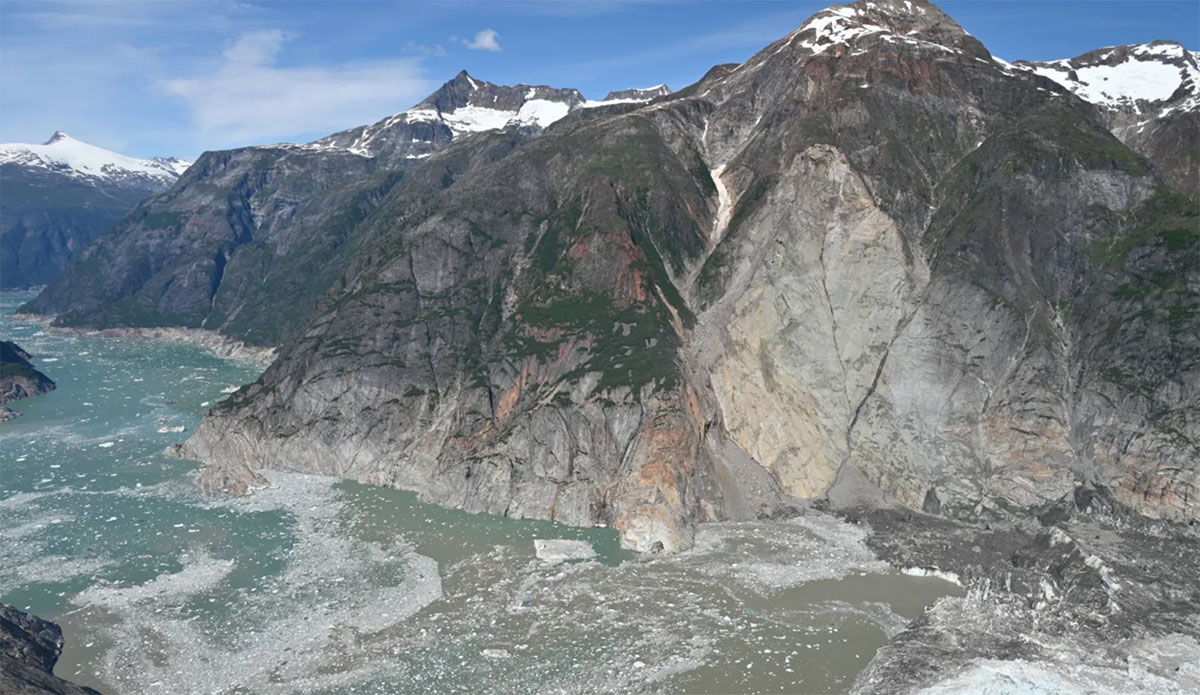

On August 10, 2025, a huge landslide kicked off a 1,578-foot-tall tsunami in an Alaskan fjord called the Tracy Arm. Surprisingly, only a handful of people noticed it at all. For reference, the 2004 Indonesian tsunami was 167 feet tall. They were, however, caused by very different things (a subduction earthquake versus an avalanche) and had very different outcomes — but still, a 1,500-foot tsunami is… wild.
According to reports, the tsunami took place around 5:30 a.m. The landslide caused the tsunami to speed down the narrow fjord, but due to the early hour and the fact that the Tracy Arm fjord isn’t exactly the most populated place on Earth, it went mostly undetected. It’s a narrow sliver of water some 50 miles south of Juneau, and it’s often included in cruise ships’ sightseeing stops. If it had happened later on in the day, things could have ended differently.
A recent study by researchers published in the journal Science took several eye-witness accounts under consideration.
“In one account, a group of kayakers reported waking around 5:45 a.m. to water flowing past their campsite and carrying away a kayak and much of their gear,” Popsci.com wrote. “Another observer aboard a cruise ship near the mouth of the fjord saw currents and whitewater with no wave, while another eyewitness described a six-foot wave along the beach.”
The team of researchers also looked at satellite data from NASA’s Surface Water Ocean Topography satellite, as well as the seismic data recorded in the area on the morning of the event. It’s assumed that natural disturbances like this happen semi-frequently in uninhabited places, but this is one of the first times that researchers have been able to see a full sea-surface structure, thanks to the satellite. This particular avalanche and subsequent tsunami came with no warning.
“Normally with these gigantic rock avalanches, they often give some sort of warning signs in the weeks, months, years prior, when the slope is slowly moving down the mountain. It’s sagging and then it catastrophically gives way in a rock avalanche,” said Dr. Dan Shugar, a geomorphologist at the University of Calgary in Canada. “In this case, that didn’t happen.”
There was, however, a tiny bit of seismic activity in the hours prior, but it was so slight that it went unnoticed. What researchers have surmised is that the slide and wave were likely precipitated by the retreating glaciers. Areas that were once held in place by glaciers are exposed as the ice melts, becoming unstable, breaking away and creating massive waves that go unridden – and would likely remain unridden, even if we did witness them.