
When people think about surfing in Rio de Janeiro, they usually picture beachbreaks. The long peaks of Barra da Tijuca. The crowds at Arpoador. Maybe a few point breaks hidden along the coastline.
What almost nobody thinks about is a slab breaking off a tiny island a few miles offshore. A wave so shallow and unpredictable that the local crew named it after an anti-seizure medication.
They call it Laje do Gardenal.
For years, the wave existed mostly as a rumor among Rio’s big-wave surfers and bodyboarders. Everyone knew it was there. Everyone knew it looked incredible. But very few people could actually surf it.
Now, after years of trial and error, Lucas Chumbo believes his crew is finally beginning to understand it.
“We’ve been trying to surf this wave properly for more than six years,” Chumbo says. “Only recently have we started finding what I call the real Gardenal.”
The wave breaks off the Tijucas Islands, a small archipelago located just offshore from Rio’s famous beaches. At first glance, especially on a clean day, the setting looks almost tropical. Blue water. Rocky islands. The unmistakable outline of Pedra da Gávea on the horizon.
Then the swell arrives.
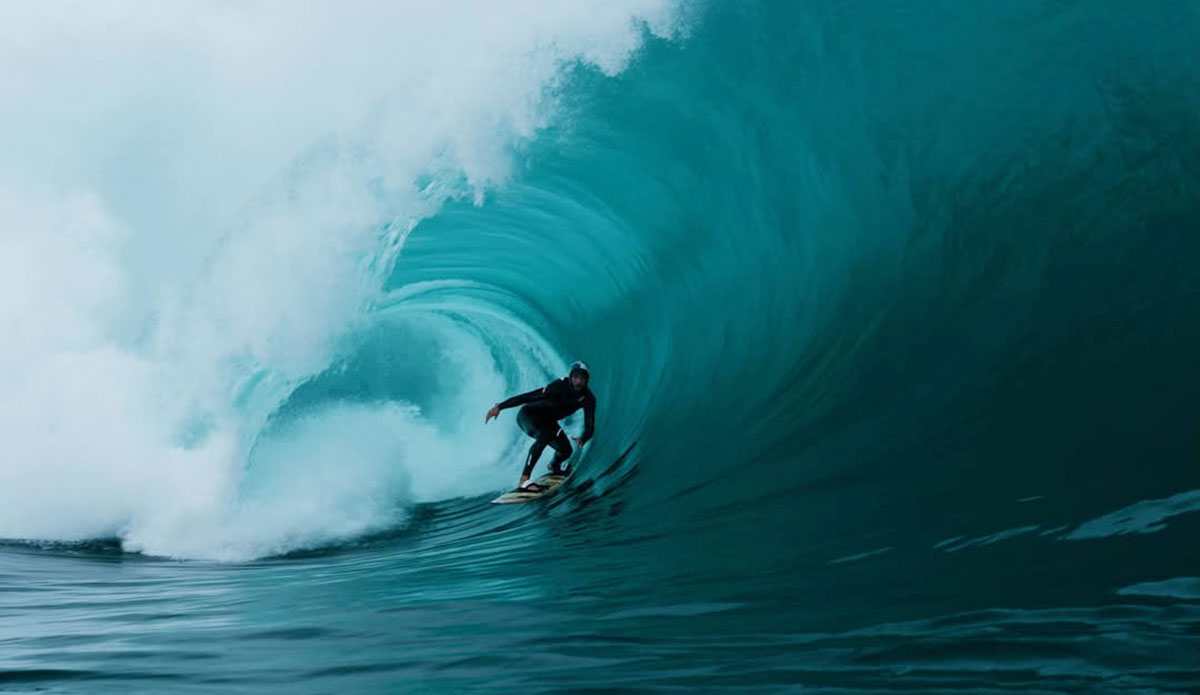
Gardenal breaks over an exposed rock shelf near the edge of the island, creating a thick, square barrel that has earned it the nickname “the Teahupo’o of Rio.” The similarities are easy to understand: both waves break over a shallow shelf, both produce heavy barrels, and both demand absolute commitment. But according to Chumbo, Gardenal comes with a different kind of danger.
“At Nazaré, Jaws, or Maverick’s, the danger is the hold-down,” he explains. “Those waves break in deep water. At Gardenal, the real danger is the rocks. If you fall there, you can roll across the reef. You can break an arm, break a leg. It’s like falling onto asphalt. Actually, worse than asphalt. It’s like asphalt covered in barbed wire.”
For a surfer whose career has been built around some of the heaviest waves on Earth, that’s saying something. The danger isn’t theoretical, either. During the session that recently put Gardenal back into the spotlight, Chumbo paid the price himself.
“On my last session, I had a pretty heavy scare. My last wave ended up being my last wave because I got completely cut up. I went really deep, grabbed the wall inside the barrel, and got rolled together with the lip. I hit the rocks, scraped my foot, scraped my hand, cut my finger, scraped my shoulder, my back, even my hip. It’s a really dangerous wave.”
The injuries weren’t enough to change how he feels about the place. “But we’ve fallen in love with it,” he says.
Ironically, the wave’s danger may also explain why it has remained largely unknown outside Brazil. Unlike many famous slabs around the world, Gardenal isn’t a place where surfers can simply show up and figure things out.
“It’s a very difficult wave,” Chumbo says. “A lot of people tried surfing it before — bodyboarders, big-wave surfers — but nobody really managed to find the deep line inside the barrel. They kind of gave up on it because it was so hard to position yourself properly.”
That challenge became Chumbo’s obsession. His relationship with Gardenal dates back to 2015, when a friend who explored the area by kitesurf introduced him to the wave.
The following year, Chumbo returned with Brazilian big-wave legends Carlos Burle and Alemão de Maresias.
“It was a heavy day,” he remembers. “That’s when we really got to know Gardenal. Before that, it was mostly stories.”
View this post on Instagram
The stories turned out to be true, but understanding the wave took far longer than discovering it.
Gardenal doesn’t break consistently. It needs a specific swell direction. A specific tide. The right wind. Even then, the best section often appears only briefly.
For years, Chumbo and his crew kept returning. “There’s a special wave there,” he says. “A perfect line. That’s what we’ve been trying to find all these years.”
Last month, the effort paid off.
Joined by Pedro Scooby, Lucas Fink, Ian Cosenza, and Michelle des Bouillons, Chumbo scored what he describes as one of the best sessions of his life.
“It was historic for us,” he says. “Everybody got waves. Michelle got incredible waves. It was one of the best sessions I’ve ever had.”
The footage quickly spread across social media, introducing Gardenal to a much larger audience. According to Chumbo, though, the public has only seen part of what happened.
“What people saw on Instagram was just a few clips,” he says. “The best footage is still being saved. There’s still a lot more to come.”
The session also reinforced something Chumbo has believed for years: Gardenal is still far from reaching its potential.
“I caught some of the best waves of my life during that swell,” he says. “But I still know there’s more. I know we can surf bigger waves there, and I know there are even better waves waiting.”
For now, Chumbo sees it primarily as a tow wave.
“I think it’s a tow-in wave,” he says. “The drop is too critical, and it’s too close to the rocks. There are guys out there who would paddle it — Nathan Florence probably would — but it’s not a very friendly wave for paddling.”
And maybe that’s exactly why it has remained hidden for so long. While Rio’s beachbreaks have become some of the most recognizable surf spots in Brazil, Gardenal spent years sitting just offshore, largely ignored because it was simply too difficult — and too dangerous — to figure out.
Now that surfers are finally starting to understand it, Rio’s most mysterious wave may not stay a secret, at least internationally, much longer.