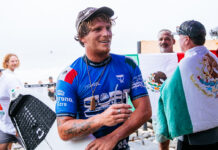
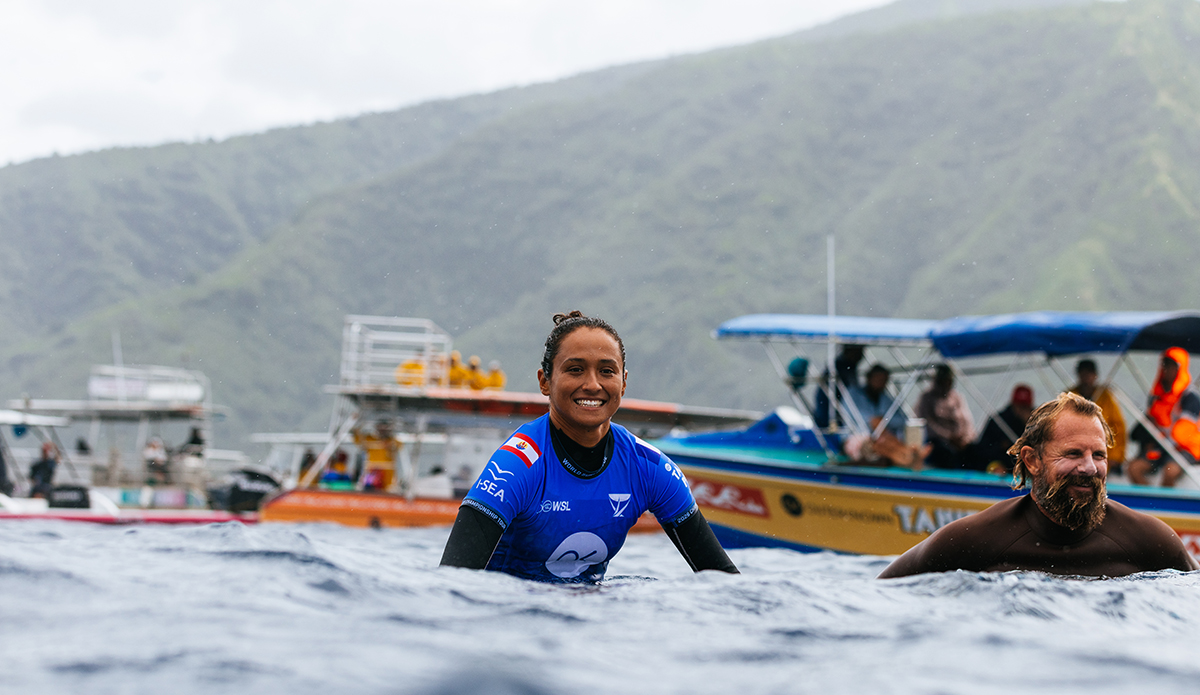

Vahine Fierro is part of the new guard of Tahitian talent that has inundated the Championship Tour – and the competitive landscape in general. She’s definitely taken her lumps on the CT, and after an early exit at her home event last week at the Tahiti Pro, she still has the back half of the year to try and move into a position to requalify for 2027. Still, her biggest moments have come at Teahupo’o, where she won the event as a wildcard and competed in the Olympics in 2024. I had the pleasure to talk with Vahine to learn more about her surfing life.
What’s your home break and how has it shaped you?
I grew up on an island called Huahine, about 30 minutes by plane from the main island of Tahiti. There are only about 7,000 people on the island, and since I can remember, I was in the ocean every day after school. Once my parents finished work, they’d take me surfing with them. My dad has a shaping room and made all of my boards until I was 18. Living on a remote island, it was pretty hard to find a surf shop! It was so cool because my dad would shape our boards, and I got to paint whatever I wanted on them.
At the time, I didn’t realize how spoiled I was — surfing world-class waves with just my parents, my sisters, and me out in the lineup. It’s still like that today because those waves are protected by the locals. We’d all be riding our dad’s boards, with maybe two or three other locals out. That was about it. It was just my everyday routine, even though now it sounds like a dream surf trip.
What does home mean to you? Why is the surfing lifestyle so special in French Polynesia?
Home is more of a feeling. There’s no place like home. It’s the comfort of home — my bed, the food, the warm water, the empty waves, the brightness. Surfing is so special in French Polynesia because of the quality and variety of the waves. It’s like surfing different kinds of wave pools. You can choose your setup: rock-bottom beachbreaks, fun reef passes, or huge Teahupo’o barrels. It’s all there, just five minutes from shore by boat.
The best part is that we’re still sharing the lineup with people we know. We take turns and share waves. I really emphasize that because lineups in French Polynesia are small, so respect is incredibly important.
Who were your idols growing up?
I grew up without Wi-Fi until I was 12, and we didn’t really get surfing magazines on my island, so I wasn’t very aware of the surfing world. When I started competing locally in Tahiti at 13, I began hearing about Michel Bourez, our surfing superstar. He inspired me with his power, combined with Stephanie Gilmore’s flow. With my poor Wi-Fi connection, that’s pretty much all I watched.
What wave introduced you to heavy surf? What’s your favorite wave and why?
Teahupo’o was the first heavy wave I ever surfed. I was 16 years old during a local contest, and I didn’t catch a single wave because I was so scared. I thought I was surfing “Code Red.” I had built up this image in my mind that the wave was a complete monster, so after losing in Round 1, I didn’t go back for another two years. Eventually, I started surfing it on smaller days. I still wasn’t completely convinced, but I was so inspired by what all the boys were doing. They looked so happy every time they kicked out of a wave, and I wanted to experience that feeling for myself.
In 2019, when I was 19 years old, I only surfed Teahupo’o a handful of times. During my last session of the year, I ended up winning Surfer Poll’s Best Women’s Barrel of the Year. Since that barrel, Teahupo’o has become my favorite wave. It gave me the confidence to keep going out there and connect with that feeling. It was never about becoming a charger at Teahupo’o or winning the CT there. It was always about chasing the feeling that made me feel alive. That’s where it eventually led me.
You’re more than a big-wave charger. How did you perfect your small-wave game?
I’ve always thought of myself as more of a small-wave surfer than a charger. I definitely became a more well-rounded surfer once I started competing. I became interested in competition at 13 — or actually, let me rephrase that. My dad told me he thought I was good enough to compete. I flew to the main island by myself for my first local contest, finished third in the final, came home crying because I lost, and told my parents, “I want to start competing.” I’ve always loved having a purpose and challenging myself.
That’s why I decided to move to the main island for school and live in a dorm. I knew that if I wanted to improve and compete locally, I needed to leave Huahine, expose myself to the “real world,” start surfing beachbreaks, and learn how to go left. I actually didn’t learn to surf left until I was 13 because I simply never needed to before I started competing. French Polynesia doesn’t really have bad waves. Everything is warm, easy, with very little current or big tides. I feel like my small-wave surfing really improved once I started competing and traveling outside of French Polynesia. Europe, especially, was a great challenge.
What did surfing in the Olympics mean to you?
Surfing in the Olympics at home was a dream come true. It was a once-in-a-lifetime experience. I didn’t get the result I wanted, but the lessons I learned are something I’ll carry with me forever.
Walk us through your CT win at Teahupo’o in 2024. Perfect run, or was there drama involved?
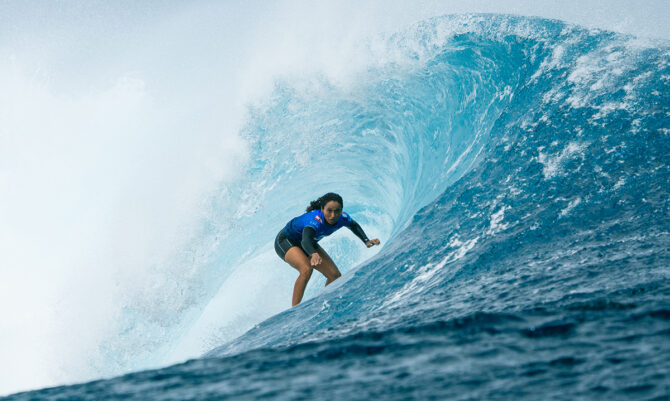
My Teahupo’o win was crazy — in the best way. Honestly, I felt like I was on autopilot that whole period. Jeremy Flores, Kauli Vaast, and I spent countless hours surfing Teahupo’o during the three months leading up to the event. I probably surfed 15 heats against Kauli and Jeremy, and I lost every single one. I couldn’t have asked for better training partners. I learned so much from those sessions, and I think that’s why my run during the 2024 Tahiti Pro was so successful. I caught some of my best waves ever, my highest scores, and even made my first-ever claim in a contest. That happened during the semifinal against Tatiana Weston-Webb. To me, that was the real final because she was definitely the surfer who was going to push me the hardest. She scored a perfect 10, and I answered with a 9.60 in the dying minutes. Then I became the first Tahitian ever to win the event. There were a lot of firsts during that competition. But that’s what Teahupo’o does to you. It gives you a feeling that’s impossible to explain.
How’s life on the tour? Was it a culture shock at all coming from the islands?
This is my second year on the world tour, and I’m so grateful to be here. It’s intense. Honestly, it feels like a completely different sport. Everything is 10 times bigger — in a good way. You learn so much from contest to contest, and it never stops. Being the first Tahitian woman to qualify for the world tour definitely came with pressure during my first year. But it also made me realize I can be proud of where I come from and bring my culture onto the Tour. Tahitians are very relaxed. Everything moves a little slower, and it’s a different rhythm. I also love freesurfing more than competing. Surfing with my sisters and friends is what I enjoy most, so finding that balance between being an athlete on tour and still enjoying freesurfing has been my biggest challenge.
Favorite person to surf with in big waves?
Kauli Vaast. He’ll probably tell you it’s because of him that I got all my good waves! It’s nice having someone you trust. Sometimes a quick pep talk — or even just hearing “Go!”— is enough to help me commit to a wave. I’m really thankful for him. I actually have a funny story.
We were surfing Pipeline when it was breaking on second reef, and there were a couple of cleanup sets from third reef. I was sitting way outside, and Kauli kept telling me to move in and try to catch a wave. The moment I finally listened to him, I got the biggest set of the day on my head. Meanwhile, he was about a meter away from me and made it through effortlessly. The whole time he was laughing so hard while I was diving under wave after wave. He’s so comfortable in big surf that seeing him laugh actually made me relax and laugh too, even while getting rolled by third reef.
Who is your shaper, and tell us about your quiver from small to big waves.
Britt Merrick is my shaper. I’ve been loving the CI Pro, from small waves all the way up to step-ups for waves that have both turns and barrels. I’ve also been riding the Mikey February model for point breaks. Raglan was such a fun wave for that board. When it’s just barreling waves, I usually ride my Happy Travelers. We actually nicknamed it the “Happy Tahitian.” I also use Quatro fins at Teahupo’o, Pipeline, and Cloudbreak.
Best travel story so far?
The best part of traveling is discovering places I never even dreamed of visiting. For me, it’s all about the people, the food, and the waves. Whenever I connect with those three things, that place usually becomes one of my top five favorite places in the world. And if I happen to get a good competitive result while I’m there, I don’t even want to come home. The adrenaline of doing well in a contest makes those memories even more special.