

What if you knew that, on the Championship Tour, the first surfer to reach a heat total of 12 points wins 82 percent of the matchups? Or what if you had a tool that could accurately predict the winner of a heat three-quarters of the time? Would you change how you surfed, how you coached, or how you bet?
Data decision-making has been infiltrating major professional sports for decades. In baseball, the use of advanced metrics to evaluate players became the subject of Moneyball, the 2011 Hollywood flick about how the Oakland Athletics successfully used math formulas instead of emotions to assign value to players. Now, a new surf-statistics company is betting that surfing could be next.
The aforementioned statistics came from VORTEX, a startup that is logging every maneuver of every surfer of every event on the 2026 CT to view competitive surfing in a new light. If its data-crunching catches on, it could change some of the sport’s most fundamental decision-making: how surfers strategize heats, how fans wager money, how media chooses storylines, or how sponsors value a surfer.
“When you actually strip the surfing, the style, and the emotion out of what’s being recorded, it becomes glaringly obvious what winning and losing heat architecture actually looks like,” said Alan Boyd, VORTEX’s Founder and CEO. “The guys who are winning the most heats are doing the same thing over and over again because it’s working for them. You can actually see these extremely powerful tendencies.”
Boyd is an admitted surf geek who has obsessed over the minutiae of surfing. Growing up surfing in Florida, he would reverse-engineer the techniques of his naturally talented friends, and for two decades he logged the details of his own surf sessions in a notebook.
A year-and-a-half ago, he harnessed his engineering and design background to turn those notes — and fascination with performance — into VORTEX. The company has tested the system with surf coaches, WSL judges, a former world champion, and Olympic federations. After discovering that AI analysis couldn’t achieve the accuracy they strive for, the VORTEX team has painstakingly logged every detail of the 2026 CT by hand to plug into its proprietary algorithms: more than 400 heats, 5,300 waves, and 12,000 maneuvers.
“VORTEX can capture more than 100 distinct data points on a single wave,” Boyd said. “Our richest recorded wave currently contains 172 separate observations, spanning competitive context, scoring, tactical state, maneuver execution, spatial geometry, timing, and outcomes.”
Just a few weeks into the public launch, the consumer-facing version of the product has started to take off. The WSL broadcast referenced VORTEX stats at the Tahiti Pro to highlight how much more time Seth Moniz had spent in the tube than his competitors. The company’s humble 700-strong Instagram audience has earned some heavy-hitting follows, including former WSL commissioner Jessi Miley-Dyer, action sports personality Chris Cote, and CT surfer Yolanda Hopkins.
The WSL already provides several statistical tools, including head-to-head matchups and historic performances at events. But Boyd says those metrics are limited in several ways. A surfer’s performance is more influenced by their decisions and execution than who they are facing; a single score can’t capture the whole context of a wave; and the WSL points system groups surfers together even when their performances within a round can be dramatically different. Boyd is using calculus to identify those points of differentiation, and ranking surfers on how they perform rather than accumulated points.
“A nine-point ride compresses an enormous amount of competitive information,” Boyd said. “Was he trailing? Was he smashing the other guy? What were the maneuvers? What was the score that he needed? What was the competitive situation?”
Now with this information at his fingertips, Boyd has noticed several interesting trends that conventional stats haven’t captured.
He points to how Alan Cleland — who has run into tough matchups this season — surfs fewer waves than his opponents, limiting his opportunities. Before Jordy Smith got injured, he was the best-performing surfer without priority. Oscar Berry, who has yet to win a heat, is completing his turns 86 percent of the time — the worst rate on the men’s or women’s tour. Meanwhile, Sawyer Lindblad, the third-ranked woman, completes 98 percent of her turns. Only Cole Houshmand falls less, with a 99 percent completion rate.
Of course, completion percentage doesn’t mean much if you aren’t risking radical maneuvers, but other statistics that Boyd divulged could have more direct influence on how heats are surfed.
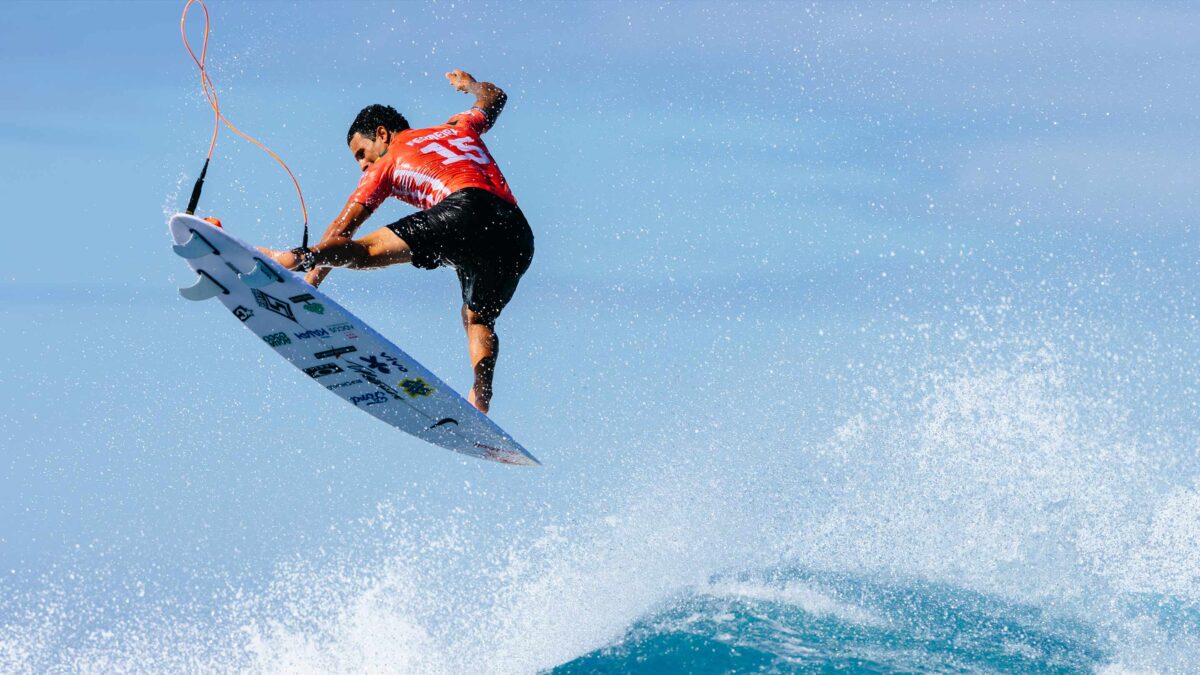
During the 2026 season, in heats where at least one surfer gets a 12-point total, the first surfer to get to 12 wins 82 percent of the time. It pays to put the pressure on your opponent early. Italo Ferreira, notorious for catching a high volume of waves, has ridden 85 waves after reaching a 12-point heat total this season. Only 15 of those waves improved his score, suggesting that he could perhaps be a bit more selective, or that he simply enjoys hucking a Hail Mary at the end of the heat. (Fun VORTEX fact: Italo has landed more airs this season (32) than anyone else has attempted.)
The implications extend beyond heat strategy. VORTEX isn’t a sports gambling site, but as betting on surfing becomes increasingly accessible, the company has developed a tool to predict which surfer would win a heat against another. During the first half of the Fiji Pro, VORTEX was asked to predict the outcome of 26 heats, and it hit the mark on 73 percent of the winners.
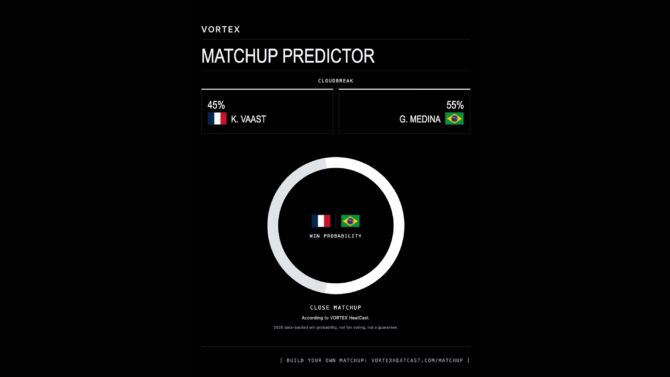
It’s a small sample, but sports gamblers must be curious.
“A deeper truth is beginning to emerge,” Boyd said. “Heats are won not by maneuver quality alone, but through heat architecture — the sequence of choices, opportunities, and scores through which victory is constructed.”
If VORTEX is onto something, the implications could stretch across the sport. Could a sponsor value one surfer over another based on a deeper understanding of their competitive performance? Would a coach change a surfer’s approach to a heat based on data decisions that lead to wins? Could bettors gain an edge with a prediction tool?
The ocean’s unpredictable nature may never let statistics take over surfing like analytics did in baseball. But there is undeniably a wealth of unexplored data in surfing, and perhaps an advantage for whoever figures out how to harness it first.