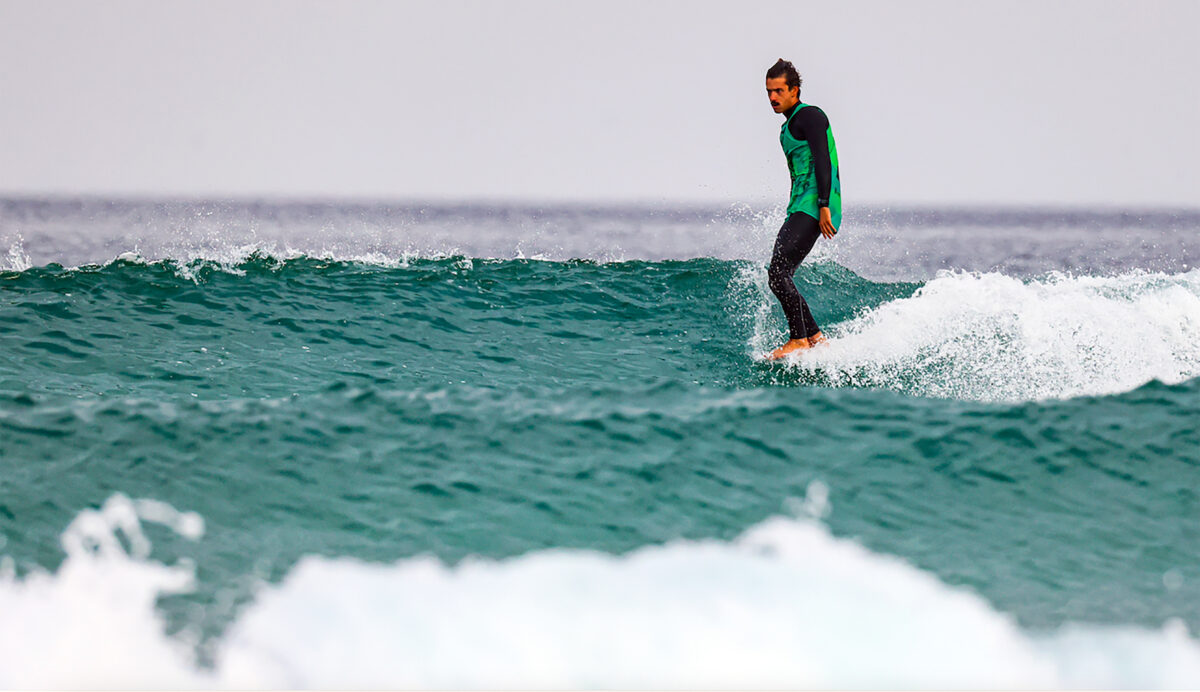
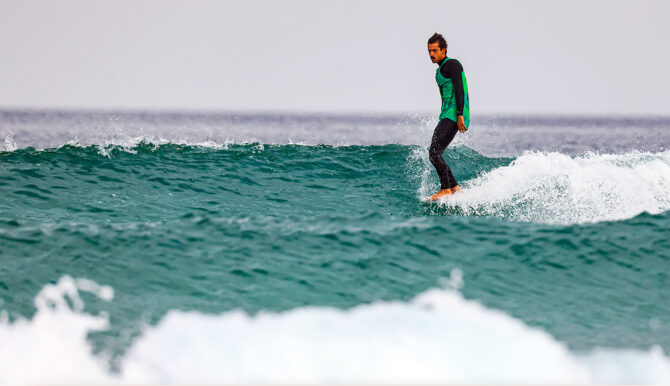

Louis Marchiset is a professional surfer from the French Basque Country who’s trying to push the limits of what people think is possible on a longboard. Hanging 10 in 10-foot Hossegor. Getting barreled on a nine-foot board in Tahiti. And surfing some of the most beautiful waves in the world while showing that longboarding belongs in places where people don’t always expect it. He wants to show that it has its own identity, its own challenges and still has so much potential left to explore.
I sat down with the man to get a glimpse into his surfing world.
Where are you from and how did it shape you as a surfer?
I’m from the French Basque Country, in the southwest of France. I grew up between Bidart and Biarritz, and I’ve been surfing since I was three years old. My home break is probably Parlementia. It’s where I’ve spent countless hours in the water, in all kinds of conditions. It’s a wave that rewards patience more than aggression. You have to read the ocean well, position yourself perfectly, and make the most out of every section.
Growing up there taught me that surfing isn’t just about performance. It’s about understanding the ocean. Long walls force you to think ahead, to link turns with flow instead of rushing every maneuver. I think the reason I’m always trying to push the limits of longboarding today comes from Parlementia. It has always given me an adrenaline rush that very few longboard waves can offer. It made me realize that longboarding can be powerful, committed, and exciting — not just graceful.
At the same time, being surrounded by waves like Côte des Basques constantly brings me back to the roots of longboarding. It reminds me that style, flow and elegance are just as important as commitment. I feel incredibly lucky to have grown up in a place where I could combine those two worlds: the grace of traditional longboarding and the thrill of riding powerful waves.
Why ride a longboard in the age of the shortboard?
I never really felt like I chose longboarding. It just happened naturally. Growing up, everyone around me was riding shortboards and that was the obvious path if you wanted to compete. But every time I rode a longboard, I felt something different. There was more freedom, more creativity, and more room to express yourself.
What attracted me wasn’t that it looked easier — it definitely isn’t. I loved that a longboard lets you use the entire wave. You can walk the board, trim, noseride, carve, surf in the pocket or from the rail. There are so many ways to draw a line. I also loved that there were still so many things to explore. I never understood why longboards should only belong in small, perfect waves. I wanted to see how far I could push them in powerful surf and challenge the idea of what was possible on a nine-foot board. For me, longboarding isn’t an alternative to shortboarding. It’s its own discipline, with its own history, technique and endless possibilities.
Who were your idols?
When I was a kid, my biggest inspirations were Antoine and Édouard Delpero. They were surfing here in the French Basque Country, so they felt close to home. But more importantly, they were surfing every kind of wave. They showed me that longboarding wasn’t limited to perfect point breaks. Internationally, I looked up to Harley Ingleby and Taylor Jensen for their incredible level of performance. At the same time, I was fascinated by a more classic approach through surfers like Harrison Roach, and by someone completely different like Alex Knost, who showed that surfing could be creative, unpredictable and fun.
Today, I watch a lot of Duane DeSoto and Kai Sallas. I also really admire Clovis Donizetti. His surfing looks so simple, but that’s exactly what makes it so difficult. There’s nothing forced — just perfect timing, positioning and flow. To be honest, I’ve never really had one idol. I’ve always tried to take a little bit from everyone because they all have their own identity and their own way of understanding a wave. In the end, all those influences helped me discover my own style rather than copy someone else’s.
Favorite wave?
Parlementia, by far. Every time I go there, I feel at home. Sometimes I just sit on my board, look at the coastline and enjoy being there before even thinking about catching a wave. It’s a really special place for me. What makes Parlementia unique is its range. You can surf it when it’s 50 cm or when it’s six meters. I’ve spent my whole life there, so it’s become my playground. Every swell teaches you something different. I’ve been lucky enough to travel a lot recently, and one thing I’ve realized is that the grass isn’t always greener somewhere else. Of course, I love legendary waves and the stories behind them — Teahupo’o, Jimmys right, Anchor point even Byron Bay for its incredible surf culture — but every trip has made me appreciate home even more. That said, I’m still chasing a dream wave. I’d love to find a wave where I can do a really committed noseride, step back, and then pull into a big, wide barrel… or maybe even get a noseride inside the barrel! (Laughs.) I don’t know if that wave exists, but that’s what keeps me searching.
What makes longboarding stylish?
For me, style is what makes longboarding different from every other discipline in surfing. Style isn’t about looking cool. It’s about making difficult things look effortless. It’s the way you move, the way you read the wave, your timing, your posture, your footwork… everything has to feel natural. I think every surfer should develop their own style instead of trying to copy someone else’s. That’s what makes surfing beautiful. You can recognize someone from a distance just by the way they draw a line on a wave. At the same time, I don’t think style and performance should be separated. Some people believe you have to choose between traditional longboarding and progressive longboarding, but I disagree. The best surfing, in my opinion, combines both. You can be stylish while still pushing the limits of what’s possible on a nine-foot board. I think longboarding is evolving in a really exciting way. More and more surfers are taking longboards into powerful waves, experimenting with different lines and showing that the board has far more potential than people once believed. My only hope is that, as the level keeps rising, we never lose the soul of longboarding. Performance should never come at the expense of style, flow and respect for the history of our sport
Thoughts on the current state of professional longboarding?
I love competition. I love the performance side of sport in general, whether it’s surfing or any other discipline. Competition pushes you to improve and it’s something I really enjoy. But when it comes to longboarding, the challenge is that everyone has a different vision of what great surfing is. Like I said before, every surfer brings their own style, their own approach and their own understanding of a wave. The problem is that it’s very difficult to compare those different styles because they can all represent excellence in their own way. Personally, I feel like there is a group of surfers who are really pushing the technical side of longboarding forward, but sometimes the scores don’t always reflect that. I think part of the difficulty comes from the fact that longboarding is still very connected to culture and personal interpretation. What one person sees as the highest level of performance might be seen differently by someone else. I also think there is still a challenge for surfers outside the traditional longboard countries. Coming from Hawaii, Australia or the U.S. can sometimes give you a stronger connection with the culture and history of the sport, while surfers from Europe or Asia may have to work harder to get the same recognition. I would love to see the longboard tour become a bigger show. Longboarding is more popular than ever right now, with a lot of people reconnecting with the style, equipment and lifestyle, but I don’t think the competition side is getting the attention it deserves yet. I think the future is exciting if we can find a way to celebrate all the different expressions of longboarding while still pushing the level higher.
Should it be in the Olympics?
Absolutely, I think longboarding deserves a place in the Olympics. Beyond just competition, it would bring a completely different level of exposure and recognition to the discipline. Longboarding has so much history, culture and diversity, and I think the Olympics could help people discover that there is much more to it than just riding a bigger board. It could also bring the development and attention that longboarding deserves. The sport has all the ingredients to create a real show: incredible athletes, different styles, powerful waves and a unique culture. I think it could be the platform that longboarding has been waiting for.
You’re trying to reinvent the surf lesson…
Longboard Lab is my own project. Since I was young, I’ve always enjoyed helping people around me improve their surfing. I loved sharing knowledge, explaining things and seeing someone have that moment where something clicks. After getting my surf instructor diploma, I started working more in the industry, but I sometimes felt disconnected from the side of surfing I truly believed in. Surfing was growing so fast, and sometimes it felt like the focus was more on getting people in the water than teaching them the culture, the responsibility and the connection with the ocean. One of the things that really bothered me was seeing people leave a lesson and, a few days later, come back to the same spot without really understanding how to surf safely, respect other surfers or read the ocean. That’s why I created Longboard Lab. I decided to focus only on private coaching for intermediate and advanced surfers. The goal is not just to improve technique, but to help people become more independent, understand waves better and, most importantly, know how to share the lineup with others. For me, a good surfer is not just someone who can do big turns or difficult maneuvers. A good surfer is someone who knows how to have fun without taking away someone else’s fun. I’m lucky to have many local surfers who come back regularly because they finally feel comfortable and confident in the water again. With Longboard Lab, I finally feel like I’m contributing to the side of surfing I believe in. I hope that, in the future, this vision of teaching surfing with respect and awareness can become as important as the business side of the industry.
Tell us about barrels and longboards.
Putting a longboard in a barrel is not as simple as many people think. There are a lot of misconceptions about it. People often say: “You can take off further out,” “a longboard holds better in the barrel,” or “it’s faster.” But honestly, most of those things are not true. The biggest challenge actually starts before the takeoff. Because a longboard paddles faster, you have to be very precise with your positioning. If you’re too deep, you don’t have the control to adjust like you would on a shortboard. So I often have to sit more inside, sometimes closer to other surfers, but never too far behind because the worst-case scenario is missing the takeoff and getting caught by the lip. Once you’re on the wave, everything becomes about being extremely subtle with your rail. A longboard carries a lot of speed and momentum, so you can’t force your turns. Your line has to stay smooth and precise. Sometimes that even means going underneath the lip because you don’t have the same ability to make quick adjustments. Inside the barrel, it’s a completely different challenge. The foam ball behind you can easily hit the tail of the board and throw you off balance. You don’t want to be too far ahead of the barrel, but you also can’t let the wave catch up with you. And then comes the exit. If the wave is closing out, you have to find a way through the collapsing section. If the barrel is really hollow, the challenge is getting out without the nose diving into the face. Honestly, it’s one of the hardest things I’ve ever tried on a surfboard, but also one of my biggest passions. There’s something so special about combining the elegance of a longboard with the commitment of a barrel. You just have to accept that sometimes the price of pushing those limits is breaking a few boards. (Laughs.)
Leash or no leash?
The leash question is always a big discussion, especially with longboarding. A longboard is much more fragile than a shortboard, and in heavy waves the leash can actually create a lot of tension. When a nine-foot board gets caught in violent turbulence, the leash can pull the board in unpredictable ways and sometimes make the impact even harder on the board. Since I started surfing without a leash in certain conditions, I’ve actually noticed that I break far fewer boards. Without a leash, I feel more connected to the wave and I’m more responsible with my positioning because I know I have to make the wave or take the consequences. That being said, I think it depends on the situation. Safety always comes first, especially in crowded lineups or waves where losing your board could put someone else in danger. For me, when I’m surfing powerful waves with the right conditions and enough space, going without a leash is part of the experience. It forces you to be more aware, more committed and more respectful of the ocean.
Fin set up?
My fin setup really depends on the type of wave and what I’m trying to do. For more performance longboarding, especially when I want to push the board hard, I really like the Harley Ingleby FCS II thruster setup. It gives me a lot of drive, control and confidence when I’m surfing more aggressively. When it gets bigger and I’m looking for barrels, I love the Nathan Florence FCS II quad setup. It feels really fast and gives me that extra hold and speed when I need to fit a longboard into a powerful section. For noseriding and a more traditional approach, I usually ride a 2+1 setup. I use the Delpero model from Roam Surf, with a 7.5 or 8-inch center fin depending on the size and power of the waves. For me, the fin is a huge part of the personality of a longboard. The same board can feel completely different depending on the setup. It’s like changing the character of the board depending on the wave you’re surfing.