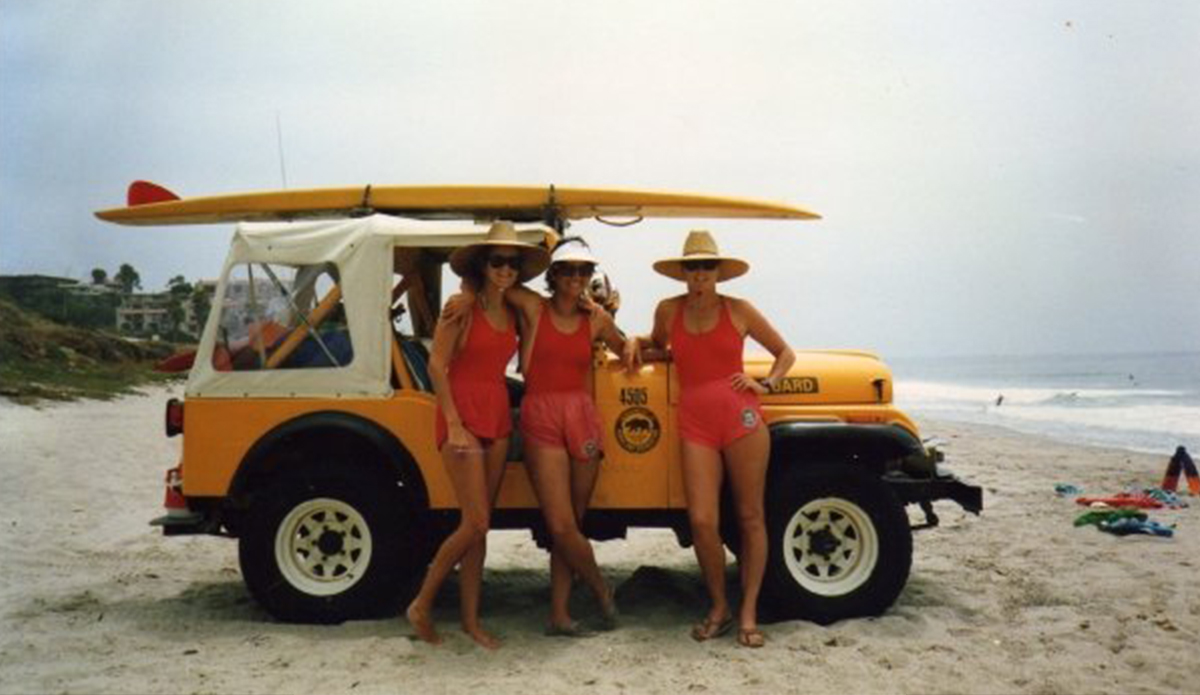
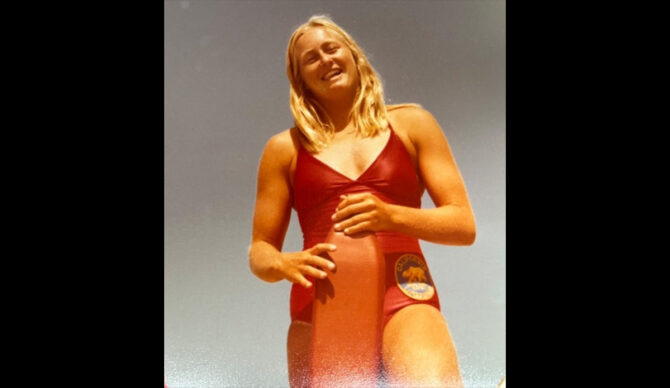

Nowadays, seeing a female lifeguard patrolling California beaches is a normal sight. But that wasn’t always the case. When Debbie Friedman broke into the male-dominated profession of lifeguarding in the 1970s, women were still fighting for a place in the towers. Realizing that this chapter of California — and surfing — history had largely gone untold, Friedman set out to unearth these stories, collecting her own experiences and those of other trailblazing women in a new book, GUARDED: Women, Water, and Saving Lives.
When Friedman was poring over the literature about this era of lifeguarding history, she noticed that many of the stories during the pivotal years she patrolled California beaches were missing.
“I just felt like there was this void,” Friedman said over a phone call with The Inertia. “And then, in a moment of weakness, I just found myself with my old crew and said, ‘I’m going to write a book about women in lifeguarding.’”
Friedman grew up between Los Angeles and Orange County, but unlike many lifeguards, she wasn’t raised as an ocean swimmer. Instead, she was a strong competitive pool swimmer. She learned that lifeguarding was a good summer job and figured her swimming shape would translate well to protecting beaches. (Plus, the $5.10 per hour pay was pretty good.)
When she showed up to the lifeguard tryouts in Huntington Beach in 1978 and lined up with 100 other candidates, she looked around and realized that she was the only woman. She ended up getting hired and worked between San Clemente and Huntington Beach.
It had been seven years since Joyce Hoffman became the state’s first female lifeguard in Del Mar in the modern sense of the profession, but there were still major barriers keeping women from obtaining those jobs.
Some supervisors worried about inconsequential issues like which locker room they would use. Others questioned whether women could meet the physical demands — even though, Friedman says, many of the men raising those concerns couldn’t pass the same fitness tests themselves. And because each California lifeguard agency operated independently, women often had to break the same barrier over and over, becoming the “first female lifeguard” at beach after beach.
“Some of the things that were held up as obstacles, rather than blaming somebody for it, I think it was just fear of the unknown,” Friedman said. “They hadn’t seen it before. Times were changing so fast, but the way it comes across in my writing, now we get to laugh at it. The guy with the cigarettes and the beer belly wanted a woman to do the 10 pull-ups. But what was he doing?”
Friedman goes beyond chronicling how women broke into the profession. After all, they had to save lives just like their male counterparts while confronting the same realities of the job — from recovering bodies to responding to fatal crashes along Pacific Coast Highway.
One of the defining moments of Friedman’s career came years after she had left lifeguarding. While walking on the beach in Santa Cruz County with her children, she spotted a man in distress in a powerful rip current. Grabbing the fins she always brought to the beach, Friedman swam out and rescued him. If she weren’t there, she believes it would have ended in tragedy.

While the book’s themes are relevant for anyone interested in California history, Friedman believes they resonate deeply with surfers. She sees parallels between lifeguarding and surfing, particularly in crowded lineups, where territorialism often overshadows cooperation.
Surfing has “the same peer pressure lifeguards put on each other rather than training each other, knowing that you’re going to mess up,” Friedman said. “Our common theme is our love for the ocean. If somebody’s out in the ocean without the awareness or the knowledge of what it means to be in this place, this gift, to treat the environment with the utmost respect, help them be the best they can out there.”
For readers who pick up the book, Friedman hopes they come away with more than an appreciation for how change unfolds over time — and how the lessons learned by the first generation of female lifeguards can help us navigate change today.
“We’re not going back, so how are we going to respond to change?” Friedman concluded. “Are we going to be afraid of change and treat it with great fear? Or are we going to try to help each other be more adaptable and accept it?”