
Been surfing long? How long is long?
Legend, as conveyed by surf journalists and others, has it that surfing arose a handful of centuries ago in Polynesia and was discovered, or first documented, during the voyages of Captain James Cook 250 years ago. Polynesians, including the people of Tahiti and Hawaii, did not have a pre-contact written language that we can access to confirm or clarify this assertion. For knowledge about early wave riding in Hawaii and elsewhere in the South Pacific, we rely on accounts set down by western explorers and colonizers.
If anyone still alive possesses the indigenous verbal history, I would love to hear it. My curiosity extends to the widely accepted description of the social hierarchy that prevailed in the lineup. Is it true that certain waves or surf spots were reserved for Hawaiian royalty? Was standing up while riding, and the impressively long and heavy solid-wood surfboards required, taboo for all but the nobility? That’s a narrative often encountered. If there’s an alternative version I’ve yet to see it. Nevertheless, it’s possible to explore the practical considerations of indigenous surfcraft like the paipo, the olo, or the alaia, including where and how they were ridden. This inherently involves an element of speculation.
Wave riding by non-humans certainly predated that of Homo sapiens. For seafaring island dwellers it’s safe to say that the skill of birds riding the updraft above the surface of ocean waves, and the accelerations of marine mammals below the surface of waves was observed with interest. Long before our ancestors possessed the ability to guide a slab of wood down the face or in front of the white water, the concept must have taken hold. Other creatures did their surfing with their bodies horizontally inclined and may have inspired swimmers to likewise utilize a breaking wave for propulsion while in the prone position. The first individual watercraft may have been recreational or practical, but I’m guessing they were ridden prone also. The advance from a floating log to a dug-out canoe to individual boards is a fascinating topic and a testimony to human ingenuity. What was accomplished over several millennia of nautical innovation mirrors, in condensed form, the evolution of marine life over tens of millions of years. Which brings us to the lungfish.
It takes some liberty to lump together lobe-fin fish and lungfish which can be physiologically distinct and dispersed across time. Paleontologists and animal physiologists may take issue. For a layperson though, the adaptation illustrated by these often-overlooked sea creatures that, over eons, developed the ability to survive both in the ocean and on land provides a highly relevant metaphor for surfers today. Lobe-fins and lungfish are evolutionary missing links that aren’t really missing, just overlooked. Their adaptability should be an inspiration, particularly for those of us who were there for the first explosion of mass participation surfing. Our own big bang. Decades later many of us are slowing down and even choosing to hang it up. It doesn’t have to be that way.
Consider the lowly lungfish. Rather than supple rays for pelvic and pectoral fins, used for maneuvering in the water by other fish, the lungfish has meaty lobes in their place. These appendages contain skeletal components that can support their weight and allow them to walk on the ocean floor and up onto shore. In addition, ancient lungfish that lived in the ocean possessed both lungs and gills, able to take in oxygen from the seawater and on land. Some of them eventually left the ocean and opted for an exclusively terrestrial life. They are our tetrapod ancient ancestors. The lengthy physiological evolutionary journey they followed isn’t helpful for the senior surfers trying to adapt to changing circumstances in the ocean and in their own bodies now, except as an example. Were you surfing in ’59? How about ’62? There for the shortboard revolution of ’68? If you were hooked before the introduction of the evil leash, chances are you’re having to adapt to new realities. But you don’t have to become a fossil.
Overcrowding has been fueling escapist adventures and other forms of adaptation for at least as long as surf journalism has been around. Directly or indirectly, adaptation in the form of surf exploration, wetsuit development, crowd beater longboards, gliders, etc., etc., has now been in the conversation for generations. If gills were to somehow become available, no doubt early adopters would be ready to take the plunge. Literally. Other radical medical interventions are in wide use now. Many surfing careers have been extended through joint replacement and canalplasty, for ear exostoses, to name two popular procedures. Many a surfer has had one or more vertebrae fused or a knee replaced. I’m less familiar with remedies for loss of fast twitch muscles (that’s a buzz kill) that slow down pop-ups. Anyone who surfs long enough will eventually become acquainted with the full menu. That’s especially true if, like the Hawaiian royalty of popular legend, you still surf standing.
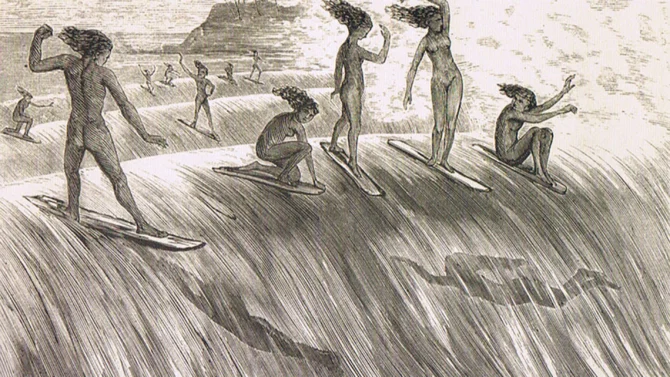
Consider, meanwhile, that worldwide, estimates for the percentage of the population with “royal blood” was less than two tenths of one percent. I’m not sure whether that estimate applies to the Polynesians, but that’s two royals out of every thousand inhabitants. Population numbers pre-contact are controversial for Hawaii, but with an estimate on the high side at 700,000 total, that comes out to 1,400 nobles. That number includes newborns and the elderly, neither of whom were likely paddling out on their olos. Piling speculation upon controversial demographics and avoiding subjects like introduced disease and indigenous birth control measures, it’s safe to say that the majority of pre-contact Hawaiians did their surfing as commoners, not as royals. Which is to say, they probably weren’t standing up while surfing. Like a dolphin, or a seal, or a human swimmer, they likely rode most waves horizontally: prone.
Leaving aside royal privilege and taboo, common sense suggests that access to a suitable tree and the resources required to craft said tree into a surfboard was not available to everyone. The effort required to fall a tree large enough to provide for a surfboard between eight and 20-feet long and then shape it with stone tools must have been out of reach for the majority of Hawaiians. Even the shorter, thinner alaia would have required a fair-sized tree, time, access to tools and the skills to complete the project. Once in the water, to catch and ride a wave standing on either an olo or an alaia would have required the strength and agility of relative youth. I would never discount the ocean abilities of the ancient Polynesians, but reason suggests the great majority of those early surfers were lying down on their short thin paipos and alaias. The earliest illustrations show a mix of prone and standing riders with different artists featuring one or the other. Who’s to say whether that was closely observed and accurate? Certainly there are other fanciful depictions in the illustrations. In short, for a variety of reasons, centuries of surfers in the lineup, young and old, were likely riding prone.
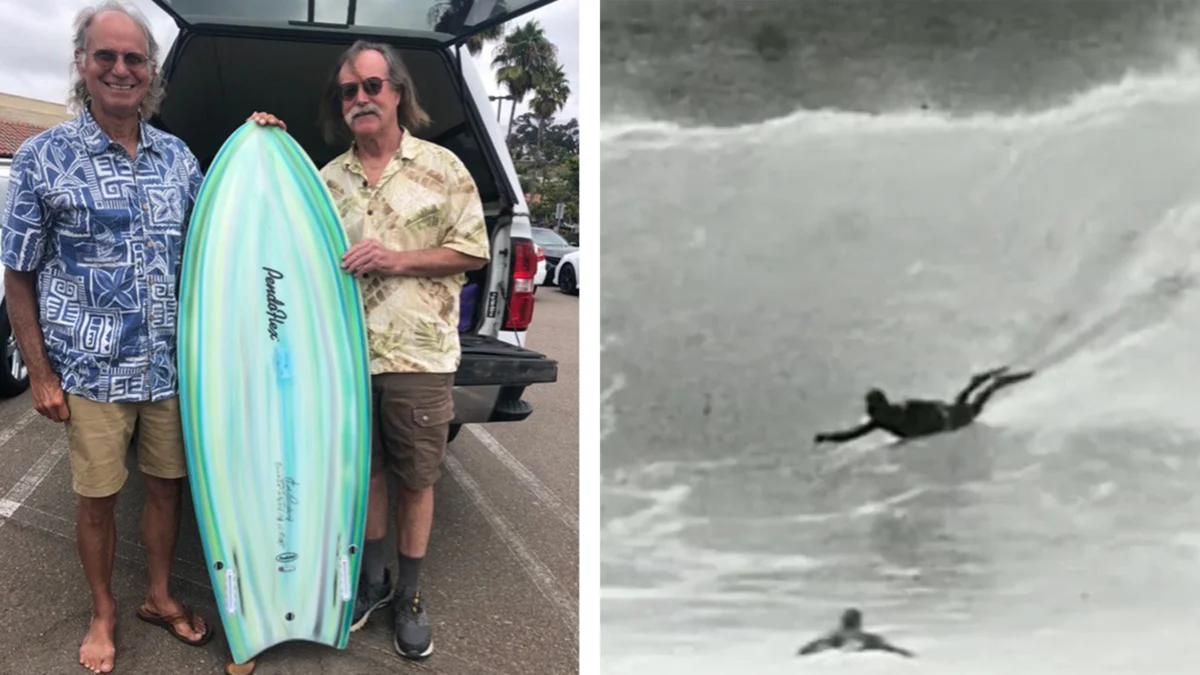
Maybe you have compromised shoulders or a trick knee? Bad backs aren’t uncommon with “mature” surfers and I’ve known people who continued surfing with multiple fused vertebrae. Both Laird and Kelly are rocking hip replacements. Some of us have two or more joint replacements and even a revision (ugh) of a replacement that went bad. If you’ve avoided all these but have been surfing for five or more decades, chances are your fast twitch muscles, needed for the pop-up, aren’t as strong or fast as they once were. Surfing can be painful when your body starts to wear out. But do you still love surfing? Still feel the same old stoke watching a well formed wave break? Do your muscle memories and neural pathways miss the angular accelerations and endorphin rush of dropping in, sinking a rail and feeling the flow?
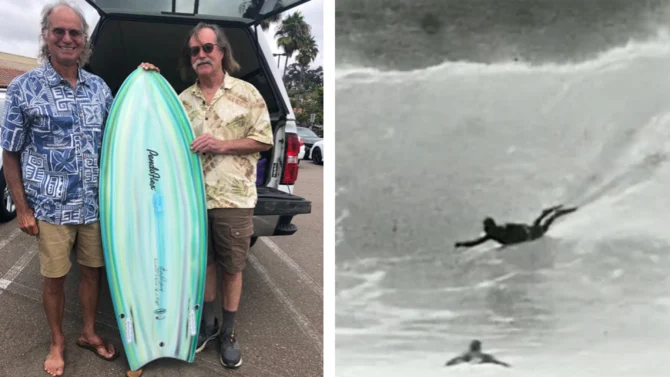
Visualize yourself getting back into decent surf using your skills of wave selection and positioning, easily handling conditions from vertical ledges to bumpy slop. Able to duck dive and choose to kick or arm paddle into waves late and deep. Tuck under the lip and make sections in waves from knee high on up. Filling your field of vision with water moving past just inches away and over your head. Escaping annihilation by pulling through the face in closeouts. Surf closer to rocks that you would otherwise and enjoy waves others give a pass. That and more is attainable for many of us when surfing prone. Maybe not standing like a royal chieftain, but still on top of the world. Most people have tried boogie boards, aka bodyboards or sponges, but there’s a difference. For me, a paipo board with enough length and volume to arm paddle when desired, and long enough that most of your body is out of the water when riding, is preferable in all but the heaviest conditions.
The options available on a paipo approach that of surfing while standing on a shortboard or mid-length (so-called). There’s more glide than on a boogie board and more body parts in contact with the board to affect trim or turn. Weighting and unweighting comes into play. All the fin options of a surfboard are on the table and you can dial in the ride characteristics that suit you for where you surf. Ditto for template, bottom contours, rails. etc. I’ve come to favor flexibility, both in the board (at the tail) and in fins. Twinzers work well, I’ve found, but that’s just one option. And, there’s room to develop technique and the equipment, leaving much left to explore. They key factor, in my experience, is having the right amount of board to either kick or arm paddle efficiently and also duck dive easily. A highly functional paipo can resemble a mini-Simmons, or kneeboard, with similar volume and dimensions, unlike the “classic” short, thin, low-flotation versions that were around in the ’60’s.
Evolution takes millennia, just ask a lungfish. But with an open mind you can make the necessary adaptations to stay stoked during your lifetime. I believe belly boards, paipos (whatever you want to call them) are an option too often overlooked by surfers approaching their body’s sell-by date. You don’t need to hang it up or meekly accept physical limitations. It’s possible to turn back the clock decades by adopting the form of wave riding that, I’m convinced, was far more common among historic Hawaiians than standing on a board. A selection of the fit, nimble and youthful stood up, including members of royal families. But did any of them ever get barreled on a 16-foot long, 160-pound olo? I kinda doubt it. Getting shacked, one of the best feelings on offer, is nearly automatic on a paipo — even for a walking fossil.