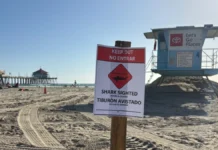
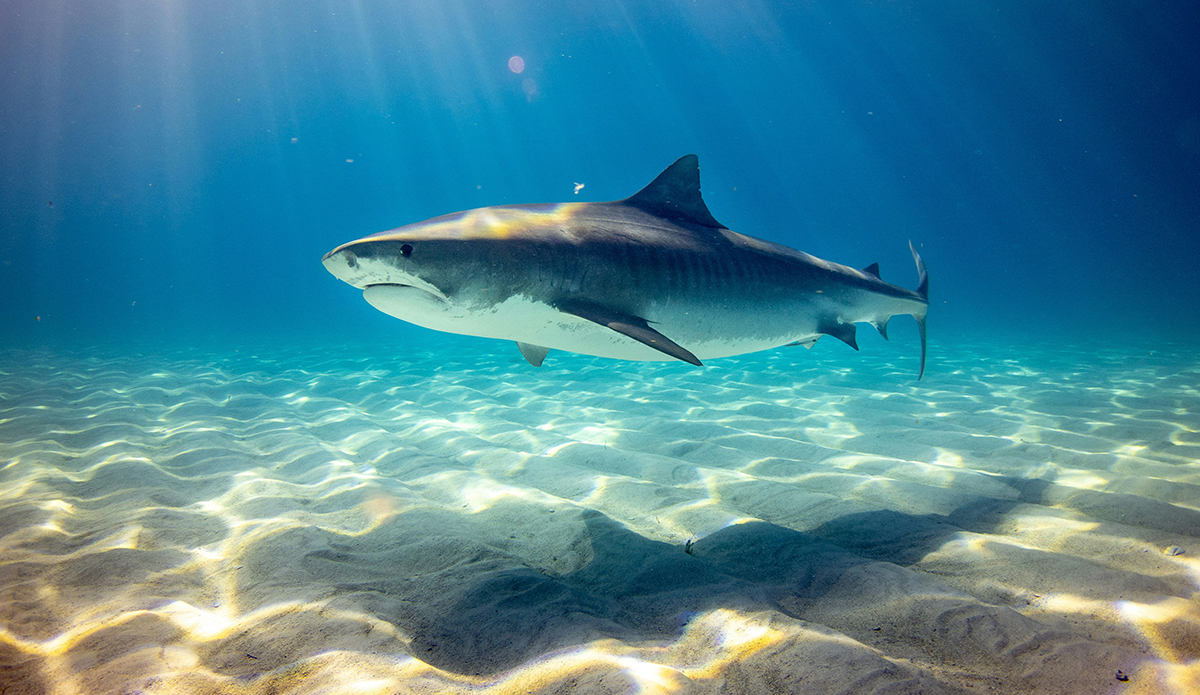

As far as origin stories go in the ever-expanding world of AI, Evan Valenti’s Safewaters.AI isn’t a bad one. About five years ago, the SEO specialist was doing AI projects in New York that predicted trends like crime and cancer, and for a bit of light relief, decided to learn to surf in Narragansett. After one session, he saw a news report that eight great white sharks had been tagged right where he’d been surfing. “I began to wonder if we could treat shark attacks like ‘shark crime’ and use similar techniques to forecast the risk for surfers and beachgoers,” Valenti told The Inertia.
The ability to forecast shark risk has, arguably, never been more pressing or more in demand. Last week in Australia, a 39-year-old man was killed by a shark whilst spearfishing on the Great Barrier Reef. This came a few days after another fatal attack on another spearfisherman at a coral reef off Rottnest Island.
As of May 26, there have been 19 shark attacks this year in Australia, six of which were fatal. In January, there had been four bull shark attacks within 48 hours in Sydney. A 12-year-old boy died in Sydney Harbor, whilst well-known surfer Mercury Psillakis was hit at Long Reef. Another shark attack at nearby Manly hours later left a 27-year-old with “life-changing” injuries.
“On our site, our database showed that our app had identified Manly and the surrounding beaches as high risk on the days of those attacks,” said Valenti. “We also successfully forecasted a high shark risk at Boca Grande, on the day of an unfortunate shark attack last June.”
The real-life data followed the theory. He had tested over 1,600 previous attacks over 200 years, and the model had correctly categorized 89 per cent of those days as “high-risk.”
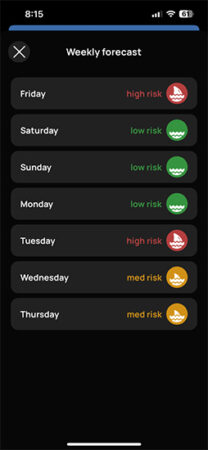
The question is how? In layman’s terms, the platform leverages sophisticated artificial intelligence methods, combining comprehensive historical shark attack records with precise marine weather forecasts to provide reliable shark attack risk assessments.
This isn’t a Large Language Model as used by AI chats like ChatGPT and Claude, but a neural network which essentially finds the relationship between the 30-plus different marine weather variable points, the attack location, and the date, then assigns a risk category out of 100. The marine weather forecasts data points include such elements as upwelling events, water temperatures, visibility and chlorophyll levels, all factors in historic shark attacks.
“A 70 percent output does not mean there is a 70 percent chance of an attack,” he says. “You can better think of it as 70 percent of the recognized patterns are there, so the risk is higher that day.” On the app, he’ll break down the risk into low, moderate and high categories.
“We aren’t wizards, it’s really just telling you the variables line up today, and the waters, statistically, will be more dangerous, so just take proper precaution,” he said. To get surfers and divers more engaged, he also added surf forecasts and visibility metrics based on chlorophyll data from NASA satellites, as well as tide charts.
He says the ultimate aim is to provide a one-stop shop for beachgoers, surfers, and divers to assess multiple conditions and make a call whether they go in the water. Or as he says, “I want to be Surfline, but with seven-day shark activity forecasts as well.”
Now it’s early days. He is still building the model, adding more inputs and charging just 10 bucks a year to get the advanced forecasts for subscribers. But his bigger goal is to see it be added as a regular feature on all weather and ocean app services so it can be used, understood and trusted by surfers and beachgoers across the world.
“Of course, the odds of a shark attack remain low, but even if we just save one life or limb a year, that’s a win in my books,” Valenti concludes. “I built this technology out of curiosity about its abilities, and so far it has proved to be incredibly accurate. Why would I keep that to myself?”