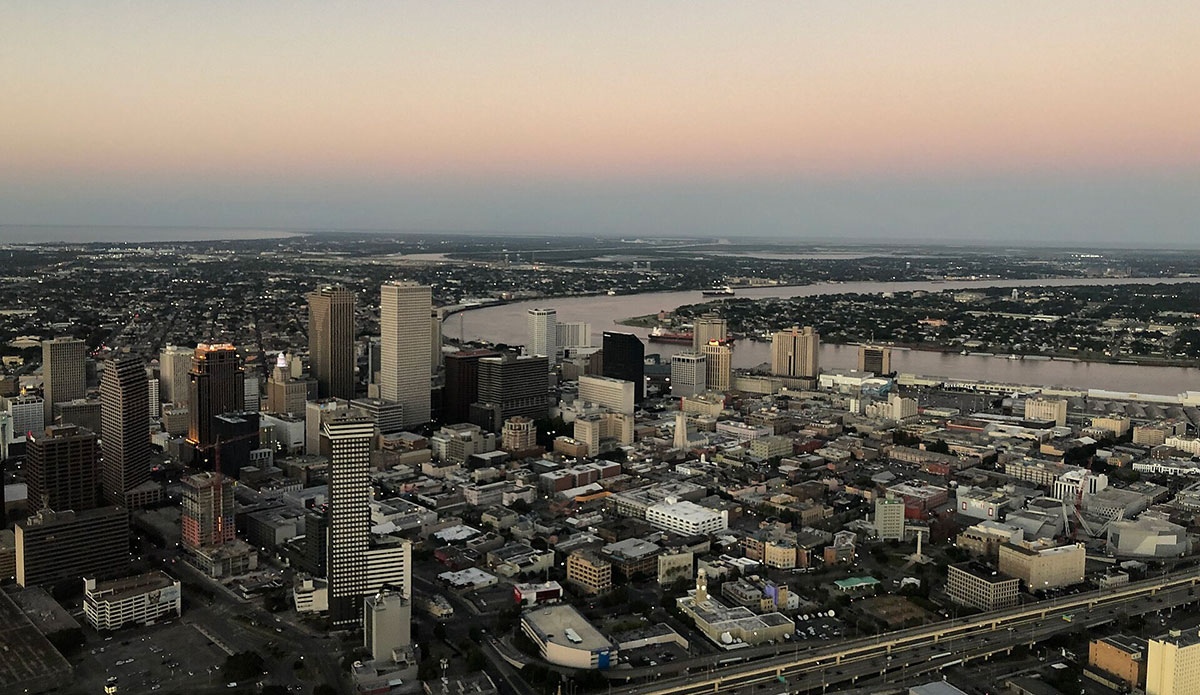

A frightening new study looking at rising sea levels is warning New Orleans officials that the process of relocating its residents should begin sooner rather than later. The city has reached a “point of no return,” meaning that within a few decades, the iconic city will be surrounded by ocean. In the immortal words of The Tragically Hip, “New Orleans is sinking man, and I don’t want to swim.”
According to the study, rising levels coupled with that fast-eroding wetlands surrounding the city will make it largely unlivable within a few generations. The study, which was published in the journal Nature, is a frightening read.
“With global temperatures poised to exceed the 1.5°C Paris Agreement threshold — a level that triggered substantial ice-sheet collapse during the Last Interglacial — low-elevation coastal zones face sea-level commitments far beyond current planning horizons,” the introduction reads. “With this geological frame of reference, we examine the impact of sea-level rise on what may be the most physically vulnerable coastal zone in the world using prehistoric and contemporary patterns of human mobility. We highlight the positive aspects of the recently commenced out-migration in this region and argue that the fate of communities landwards of this coastal zone will be decided in the next few decades.”
New Orleans is not a great place for a huge, vibrant city. It sits below sea-level, nestled in a basin with ocean on one side and marshes on the other. The coastline is being shredded to bits by the oil and gas industry, and nearly every person living there is already at major risk of flooding – as we saw during Hurricane Katrina when 80 percent of the city and surrounding parishes were under water. Things are only bound to get worse as storms get stronger and the ocean rises.
“New Orleans is not going to disappear in 10 years or anything like that, but policymakers really should’ve thought about a relocation plan a century ago,” Timothy Dixon, an expert in coastal environments at the University of South Florida, told The Guardian.
The study found that Southern Louisiana is looking at 9-22 feet of sea level rise in the coming years. That would essentially erase 75 percent of the coastal wetland and move the shoreline a little over 60 miles inland. The study compares the current situation to one that happened about 125,000 years ago, when global temperatures spiked and the sea level rose.
The researchers involved in the study called New Orleans and its surrounding areas the “most physically vulnerable coastal zone in the world.” The city itself has some 360,000 residents. The researchers believe that immediate action is required to ensure a smooth transition out of the city.
“Louisiana has already experienced population loss in recent years,” the paper states, “and this trend will accelerate in a disordered way, should no action be taken to confront the perils faced by its largest city and surrounding communities.”
Of course, in an ideal world where we had decades of warnings (heavy sarcasm alert), we could have stopped this. But it’s too late for New Orleans — at least according to the perspectives paper, which is basically an assessment of a research article.
“While climate mitigation should remain the first step to prevent the worst outcomes, coastal Louisiana has evidently already crossed the point of no return,” the perspectives paper said.
New Orleans has done a lot to save itself. Levees, floodgates, and water pumps were all installed in hazardous areas after Hurricane Katrina devastated the city. Still, though, it doesn’t appear to be enough.
“In paleo-climate terms, New Orleans is gone; the question is how long it has,” said Jesse Keenan, a co-author on the study and an expert in climate adaptation at Tulane University. “…It’s most likely decades rather than centuries. Even if you stopped climate change today, New Orleans’s days are still numbered. It will be surrounded by open water, and you can’t keep an island situated below sea level afloat. There’s no amount of money that can do that.”