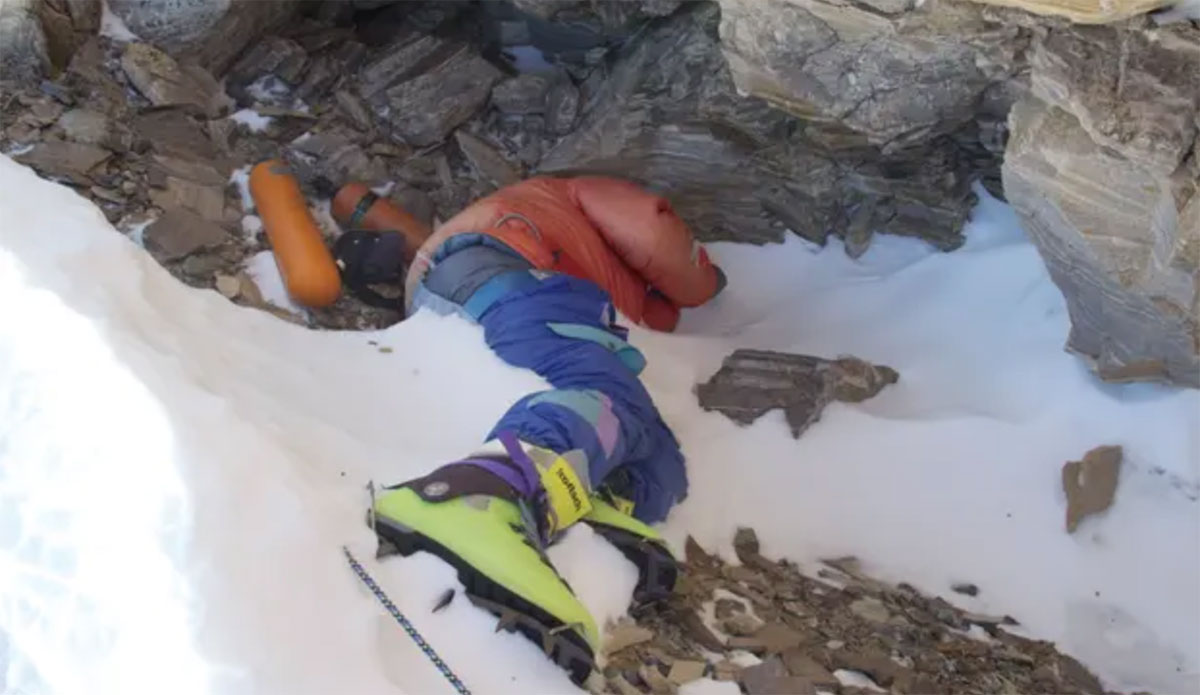
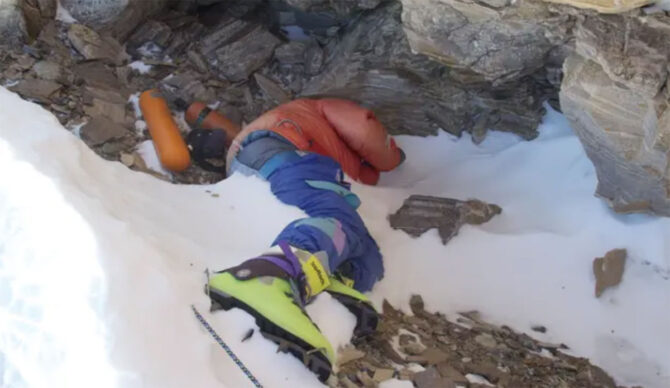

Back in 1996, a climber wearing bright green Koflach mountaineering boots died on Everest. Since then, Everest climbers have passed by his frozen corpse. Now, three decades after the unknown climber’s death, Indian authorities are planning to recover his body. He is one of around 200 bodies that litter the world’s most famous mountain, and he’s the most famous of them all.
There are a handful of theories about who owned those infamous green boots. The most likely is that it is the body of Tsewang Paljor, who was part of the Indo-Tibetan Border Police expedition and died in the what’s known simply as “The 1996 Mount Everest Disaster.” On May 10-11, 1996, eight climbers died after they were caught in a blizzard near the summit. Whoever he is, Green Boots has become a somber landmark on the mountain — a reminder that things can go very wrong, very fast. Until 2014, he rested in a small cave nearly 28,000 feet up, just 1,000 feet down from the summit. In 2014, his body was moved to a “less conspicious location”, likely by a Chinese climbing party.
According to reports, the Indo-Tibetan Border Police has issued a tender for a high-altitude recovery of Green Boots’ body. They, however, believe it to be the body of Dorje Morup, another member of the party that died in the 1996 Mount Everest Disaster.
Dying on Mt. Everest doesn’t necessarily always mean your body will remain up there, frozen into the landscape like Green Boots, whoever he was. But dying in the so-called “Death Zone,” the area above 26,000 feet, generally does. Body recovery operations at that elevation become extremely dangerous, but the tender put out for the recovery of Green Boots asks for agencies that have experience carrying out similar operations — preferably on Everest within the last five years. That, as you’d imagine, makes for a relatively small pool of possible hires.
Once a team is chosen, the difficulties will just begin. Aside from the technical aspect, there are likely to be some diplomatic hurdles, as well. The Chinese authorities will need to be coordinated with for transport across the Tibet/Nepal border, as well as a flight to Kathmandu and repatriation back to India. If all goes well, the operation should take place over the summer, when conditions are at their safest.