Support our work! The Inertia may earn a small commission from affiliate links in this article. Learn more about our gear review policy here.

While we definitely had some pretty rad gear in 2025, back then the parawinging was still very much a story of compromises. You could get killer upwind angles but not great low end, or good low end without great wind range, or incredible packability at the expense of stability – just to name a few key tradeoffs.
Well…things have changed, and in the second full year of parawing madness, we’re seeing some revolutionary pocket wings that finally tick all the boxes. The Quest is F-One’s second parawing design and the first of this new crop of 2026 parawings that offer ease of use and range on par with inflatable wings – along with all the other advantages that parawings have in terms of light weight, compactness, and stashability.
Bottom Line: I’ve flown most of the parawings out there, and my take is that wings like the Quest are going to bring a lot of new riders to parawinging. Not only is the Quest a great beginner wing, but it’s a very capable, fun, and versatile all-rounder that’s going to appeal to many experienced parawingers, with a wind range that makes it a proper candidate for full-on inflatable wing replacement.
Related: Best Parawings | Best Wingfoil Wings | Best Foils
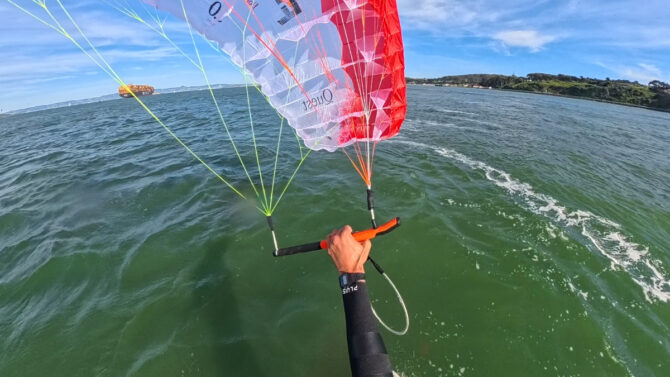
Testing the F-One Quest in San Francisco
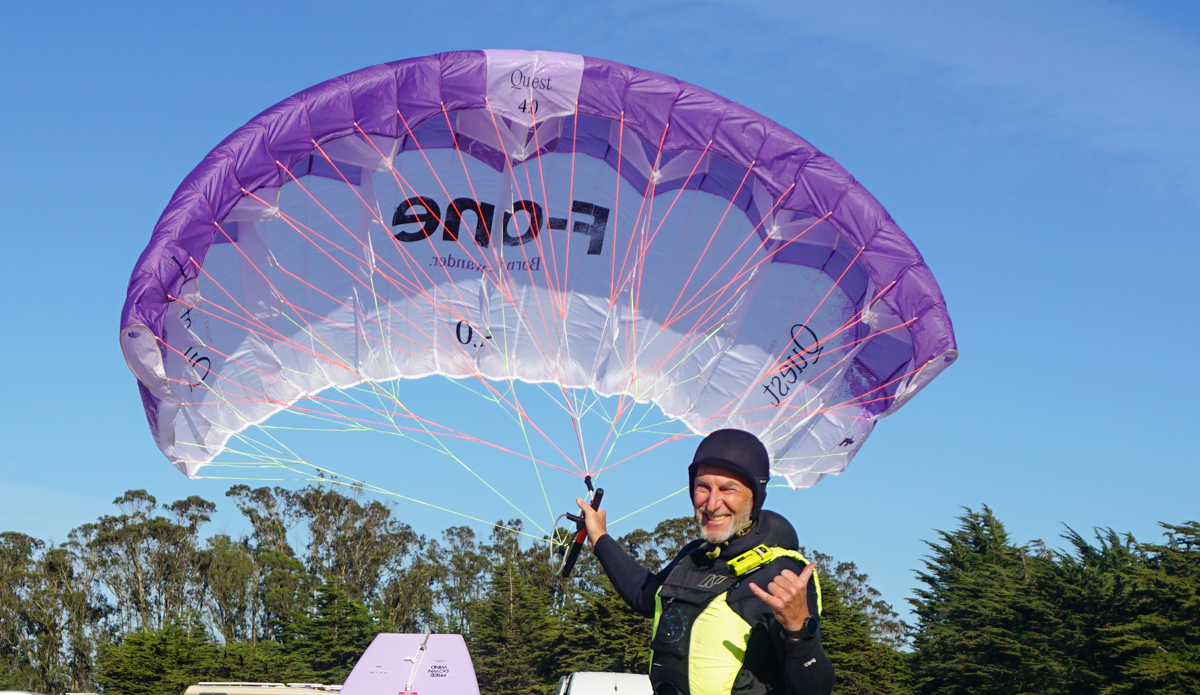
I’ve been on the water here in SF Bay since I was eight years old, sailing, windsurfing, kitesurfing, kitefoiling, winging, and parawinging, and I’ve been flying parawings here since late 2024 when the OG Maliko first hit the scene. To test the Quest, I had a full 3/4/5m quiver on hand and rode in all sorts of wind conditions paired up with a variety of boards and foils.
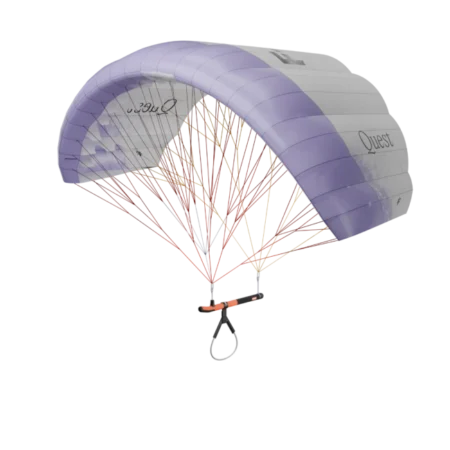
F-One Quest
Price: $999 for the 4m size at Mackite
Sizing: 2.0, 2.5, 3.0, 3.5, 4.0, 4.5, 5.0, 6.0m
Riding Style: Freeride, downwind
Parawing Type: Medium aspect, single-skin
There are a number of reasons why the Quest is gonna be a wide-ranging winner for F-One. I’ll break them into three main categories.
Ease of Use
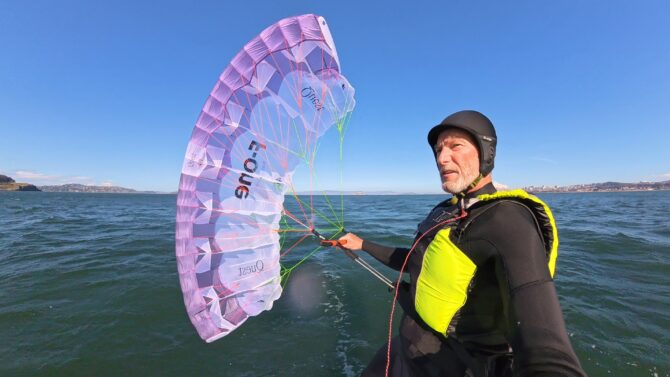
First of all, the Quest is super easy to fly. There have been some parawings that aren’t all that intuitive, and the Quest sets a new bar for ease of use. It’s not only exceptionally light and compact, but it also flies predictably and with steady power that’s easy to control.
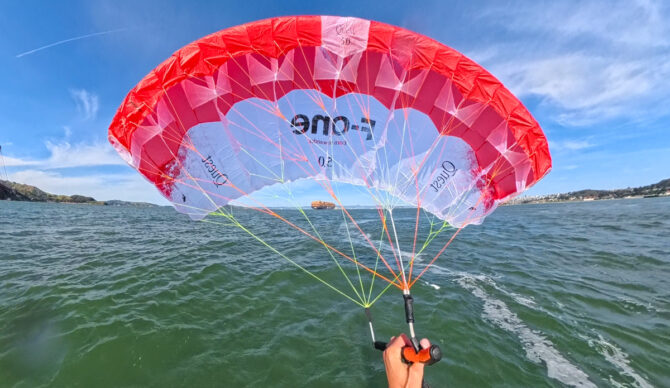
The bridle is simple, clean, and takes into account what we’ve all learned in the first couple of seasons about how to most efficiently collapse and refly a parawing, providing a highly reliable pack-down and refly with consolidated 4-A’s bridle design. I experienced no tangles at all using the Quest’s A-line collapse system, which sets a new standard for how these things should work: four color-coded A-lines, all spliced down to a single line near the bar. This design eliminates the need to pick out individual lines; collapse is efficient, immediate, and requires minimal technique. The single grab point eliminates the all-too-common “picking guitar strings” problem of same-color A-lines.
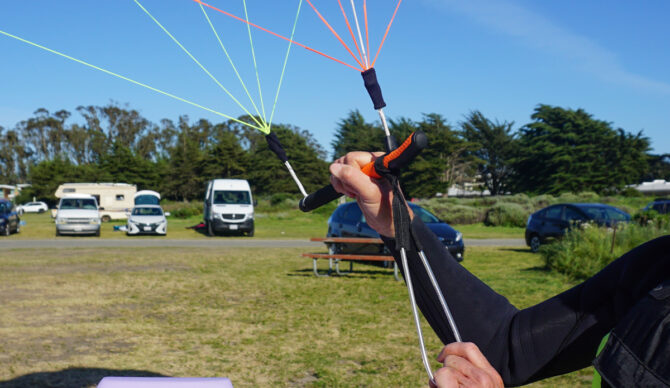
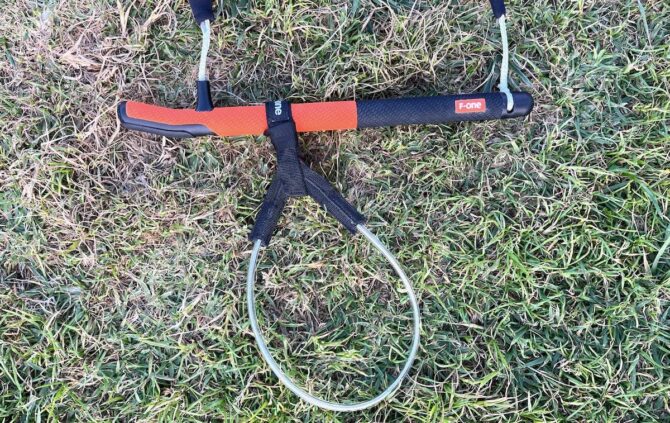
Like most other 2026 parawing control bars, F-One’s updated bar has only two bridle connections, eliminating the bothersome middle connection and freeing up that space for your hands. They’ve also incorporated an upward-bent, ergonomic bar extension beyond the A-line attachment point, allowing you to hold the wing in a neutral/A-line-pressure position without any kink in the wrist. The bend in the bar tip also helps to shed line tangles. F-One clearly took detailed rider feedback into account with the bar design, and the A-line attachment now uses a molded plastic piece that protects fingers from pinching and chafing.
Another area that I always consider is agility – and here, while the Quest isn’t the most whippy little whippet out there, it turns well, and again, the behavior is smooth and predictable. The overall package makes for a wing that’s simply a pleasure to use, and very confidence-inspiring at all levels.
Performance
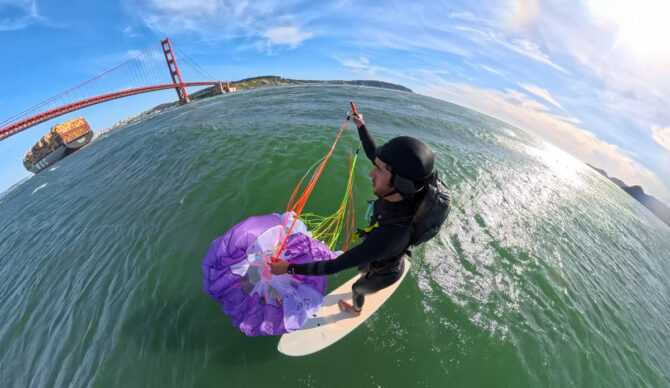
My experience was that the wind range of the 3m, 4m, and 5m sizes of the Quest corresponded well to the same-size inflatable wing wind ranges. Outside the ideal wind range, I flew the 4m in what was clearly 3m wind, and the wing exhibited no bad behavior. Of course, when I switched down to the 3m, that worked better, but it shows the wide effective range of the Quest design. I also had the 5m out on a day when others were on smaller parawings and never felt truly overpowered to the point of making the experience unpleasant.
At the low end, the Quest pumps well and sits deeper in the window than the Frigate, making it well-suited for wave riding, downwind, and all-around free riding. The wing has a wide range of effective sheeting angles, making it intuitive – and again, easy. It’s not that picky about how you trim it, and the bar provides good feedback for the back hand, which makes trimming intuitive.
While the Quest can’t quite match the speed or upwind angle of the Frigate or other upwind machines, it has something like 90 percent of that kind of mega upwind performance, and for a lot of people, that will be plenty. Said another way, you may be able to achieve just about the same effective upwind progress because the Quest is more forgiving – and other factors like the super-tight, clean, easy, reliable collapse, pack, and redeploy will be more important for many people.
Look and Feel
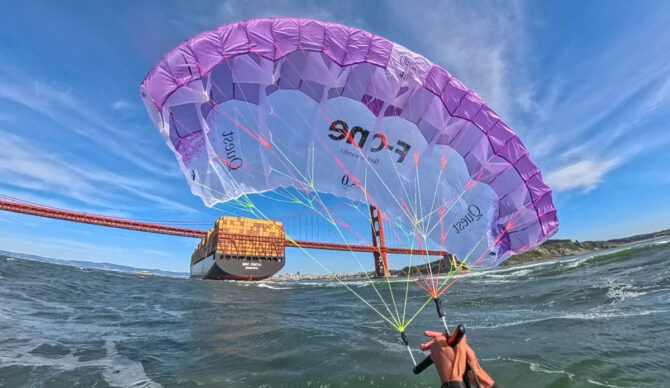
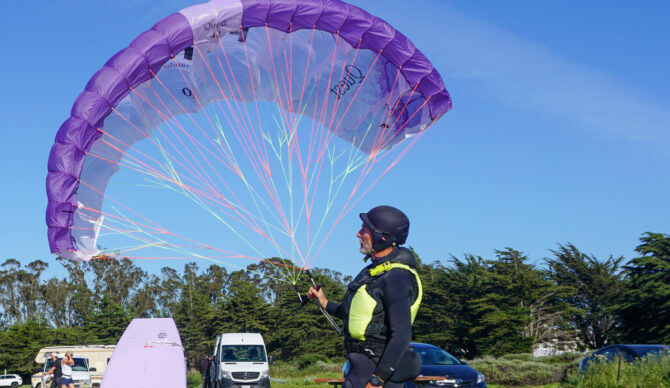
Another area where the Quest really excels is in the aesthetics, look and feel, details, and finish of the product. When you look at all the little things: how the lines are spliced, how the bar and harness line are finished, the spacious mesh storage bag (and the colors!), what you see is a fully executed, pro-level product with nothing left unpolished. Speaking of the harness line, the Quest comes rigged with a really nice single-point harness line that is stiff and clean enough for easy one-handed hook-in.
Drawbacks
The only real issue that we have with the Quest is pretty minor in that the lines are slightly thinner than on the Frigate, and they can feel a little sharp at certain points when collapsing, but they fly better through the wind. Aside from that, there really isn’t anything wrong with the Quest as long as you keep in mind that the use case for this wing simply isn’t max VMG or racing. If what you want is the fastest machine around above all else, you should look elsewhere – and of course, that’s why F-One has the Frigate.
The Competition
Since the Quest is more of an easy riding, all-around wing than an upwind screamer, there are actually fewer direct competitors. In fact, the closest competition is the Ozone Powerpack, the lighter, lower-performance, entry-level alternative to the Pocket Rocket. Looking at these two head-to-head, the Power Pack feels like more of an ultra-lightweight wave tool, and I’d give the edge to the Quest as a more well-rounded product that will appeal to a wider range of riders, with better upwind ability to boot.
That said, anyone considering the Quest might also consider easy riding all-around wings like the BRM S3, 777 PT Skin, and the Flow D-Wing v2. Of course, many riders will want to know how the Quest stacks up against F-One’s own performance-oriented Frigate. At the time of this writing, we haven’t yet gotten our hands on the Frigate v2 (slated to launch in June), but it’s fair to say that big-picture-wise, the comparison from the v1 should hold.
Simply put, the Quest is lighter, more forgiving, with simpler construction and less upwind performance, but the collapse and redeploy is even easier and better than the already excellent Frigate V1 in those respects, while the Frigate is a little beefier, rips faster upwind, and collapses and packs well – just not as minimally as the Quest. We’ve been told the Frigate V2 will have the same updated control bar and two-bridle layout as the Quest, just with a more involved internal structuring, different wing shape, and corresponding differences in performance.
Final Thoughts
While many riders are (quite understandably) focused on maximum upwind performance, the reality is that ultimate upwind speed and angles aren’t necessarily the most important characteristic in day-to-day use for many riders. As Gavin Blake put it in his review, the Quest may well be the “best parawing for getting into and progressing within the sport” – and a super-solid wing that will also serve many experienced riders who want something reliable and easy to use in all situations.
One of the first days that I was out testing this wing, it occurred to me that the “Quest” name really makes sense. It’s beautifully made, simple, reliable, compact, and just very usable — indeed, perfectly suited for a quest.
Related: Best Parawings | Best Wingfoil Wings | Best Foils