



The adage to not surf after a rain isn’t just anecdotal advice — there’s data to back it up. According to Surfrider’s 2025 Clean Water report, storm runoff is the leading cause of high bacteria counts that lead to beach closures and swimming advisories in the U.S.
Surfrider took more than 10,000 water samples across 620 locations in 2025, and listed 10 of the biggest problem areas in the report where people should avoid going in the water.
As idyllic as the Hawaiian islands look in photos, three of the most problematic beaches are in the archipelago. Punalu’u Beach Park on Oahu and Moloa’a Stream Mouth on Kauai both failed to meet health standards every time they were tested. The Haikupu’u boat ramp on Oahu also failed 82 percent of tests.
On the Eastern Seaboard, Ballard Park in Melbourne, Florida, and Miami’s Margaret Pace Park and Park View kayak launch were named among the nation’s most toxic waterways. Ballard Park and Park View have appeared on the list for three consecutive years, with the number of days bacteria levels exceeded state standards rising each year. At Park View, a no-contact water advisory has been in place since March 2020.
On the West Coast, Washington’s Thea Foss Floating Dock and three California sites — Linda Mar Beach, San Luis Creek in San Luis Obispo, and Imperial Beach in San Diego County — all landed in the top 10. The California locations have appeared on the list for the past three years.
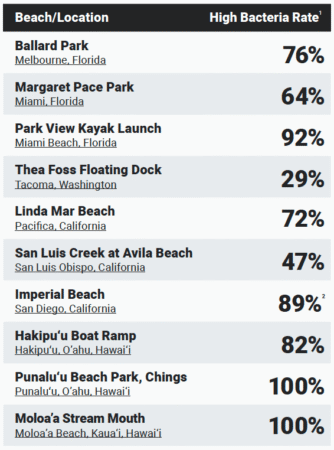
Surfrider notes that Imperial Beach data is based on closure decisions by the San Diego County Department of Environmental Health and Quality, since toxic hydrogen sulfide released from the Tijuana River can make conditions too hazardous for personnel to conduct water testing.
According to the report, 65 percent of beaches tested had at least one day with dangerous levels of bacteria. And of the 10,157 tests across the county, 23 percent met the threshold for dangerous levels of bacteria.
Surfrider says it advocatea for remedies to address issues related to stormwater runoff and old sewage infrastructure, among other factors, that lead to elevated bacterial levels. The ultimate goal of the program is to “find and fix the sources of the pollution, and to restore clean water — because no one should get sick from spending time at the beach,” the report says.